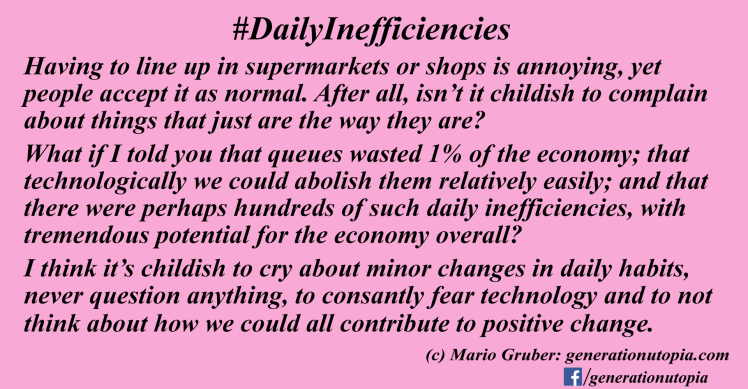
Daily inefficiency #1 out of 1000s: Lining up at supermarkets and shops
So the other day I went to a supermarket in Vienna just to buy a little snack for € 2. It took me about 45 seconds to decide on and grab the snack, but then I hit the queue and had to wait another 8 minutes. That sounds annoying, right? Well, I think it’s a much bigger deal than just annoying. A quick calculation (see below) suggests that the opportunity cost of queues is over 1% of our GDP. Moreover, I argue that this is just one little example of a daily inefficiency along with hundreds of others that because we accept and don’t push for innovation enough, is why we can’t have (more) nice things.
Naturally, because I live in Austria at the moment, the supermarket didn’t have self-checkouts. As an Austrian, I have to note that we are a few years behind with the adoption of some innovations (e.g. good luck paying with a credit card in a restaurant, let alone a Kebab shop or kiosk).
So I did what everybody would do, took out my phone to make an Instagram story and also did a little calculation. First, I counted that there were 47 people in several different queues. It is worth mentioning that the queues were extremely poorly organized, so reckless people could just skip lines.
The massive amount of value lost from this one small inefficiency
Now to the interesting part, let’s calculate how much value is actually wasted with this particular case of a daily inefficiency. GDP is a pretty good way to measure economic value, and if we want to value lost time I suggest we value it simply in income-terms. Off the top of my head the average income in Austria is about € 15/hour. So if people make € 15/hour and lost 8 minutes then that equates to € 2 per person (15/60*8). At a macro perspective this means that every single minute € 12 were wasted from the Austrian economy in terms of opportunity cost just because of this one dumb queue in this one supermarket.
Don’t panic if you disagree with measuring time in income terms, I agree that we can’t work 24/7 or measure our free-time in money, but we need numbers to get an idea of how big of a deal this is. Also, why would you value your free time less than working time? Just saying. Anyway, that’s just one supermarket, so what about queues in general? One study on queues (1) (you guessed it, it’s a British study) found that on average Brits spend about 18 hours a year standing in queues. And that’s Brits, who made almost a national sport out of optimizing queues (I lived in England myself for five years). I would guess it’s more in other countries, like Austria, where people just block each other constantly when queuing up, don’t use contactless cards as much etc.
But let’s stick with 18 hours and put that into perspective. 18 hours a year translates to around 0.3% of your waking time. That might sound like nothing much, but consider all the thousands of things you would rather do and that 0.3% of your life is gone, spent on a single thing you don’t like and have no power over. Let that sink in. Using the income deriving method from above again, 18 hours would equal to € 270 a year per person, that’s about 0.675 % of GDP (a); or two and a third working days; or almost ten percent of your holidays. Does it feel like a bigger deal already? Furthermore, I would argue that the cashier staff could be adding value elsewhere in the economy as well in that same time. And I don’t mean to offend any cashier staff, as long as the system is the way it is their jobs are absolutely crucial. It’s not necessary to know exactly how much cashier staff there is, we can just assume that on average these 18 hours per person waiting in queues means that cashier staff is serving us in retail for the same amount of time. Since they earn a bit less than average wage, I would say take another half a percent of GDP. So, overall, if there were no queues at all, we could achieve a 1.175% GDP growth (b).
I know this calculation is too simple, optimistic and doesn’t consider additional costs incurred from machines, servicing machines as well as increased customer support to help with the new systems and higher theft rates and so on and so forth. Of course, we can’t expect to get rid of all queues, e.g. at the entrance to events or where you face production capacities, e.g. at cafés (though we could extend the thought and talk about automating coffee-making etc., but not in this article).
The real problem: We don’t think about the bigger picture and hence won’t change
The point of this article is not even about the precise value that is wasted here or how much our free time is worth, you’d need some big studies for that. However, I wanted to establish an approximation and to hopefully surprise you about the extent of lost potential of something so small as queues. I think to most people queues would not seem such a big issue and is accepted as just a “part of it (retail etc.)”, but that’s exactly where the problem lies.
We don’t think about the larger implications, but as individuals we only ever think about our immediate situation (“*cry* I don’t like to do the work myself *cry*”). But that way we shoot ourselves in the foot. Instead, we should all make a habit of innovation, both in terms of thinking and behavior, because in the end of the day innovation translates into value, into more money, more free time, better health care and the list goes on and on. I cannot understand how so many of us are able to live in a world where you go to work from 9 to 5, but cannot think for 15 minutes about things that could change the world.
I personally walk around all day thinking about how things could be done better and more efficiently. When using public transport, when in a hospital, at a restaurant or café, and especially in the education system – schools are mostly a graveyard for potential, progress and a better world.
There are too many cases of inefficiency that are simply socially accepted and hence become completely locked-in and embedded, even though there are relatively easy solutions available. The tech is barely ever the roadblock, it’s mostly society (I call this the techno-social potential divergence). And even if society were more innovative, then tech would just move even faster as well. Finally, if you take all these “little” inefficiencies they add up mightily. If we sat down to brainstorm for just a day I’m sure we could find a hundred inefficiencies each worth 0.5% of the GDP, but more on that in later articles.
Technological solutions are surprisingly easy and abundant
While I mentioned above that the tech is usually the easier part as compared to social change, I do want to point out that it also pays off to do a five-minute Google search on potential solutions when you encounter an inefficiency. That would really help to put the issue in a different context, because you no longer have to feel like there is nothing that can be done about it. Here are a few suggestions to how to innovate that supermarket or retail queues in general.
First, queues could be organized better so that people don’t get so confused and frustrated. Secondly, self-checkout counters would allow more people (especially those with fewer items) to check out as you can fit several self-checkouts where now there is only one traditional counter. This would mean customers don’t depend on the bottle-neck of a lack of employees, and most importantly, some of the time they would spend waiting anyway they can now check out themselves.
Third, even more radical innovations than self-checkout counters could further minimize wait times. Some supermarkets, e.g. Edeka in Germany, offer customers to quickly scan items as they put them in the basket/trolley and then pay using their saved details without having to queue up at all. Amazon is working on a system using AI that simply recognizes who you are and what items you take so that you can just walk in, grab stuff and walk out (c). On larger shops deliveries make a lot of sense.
The game-theoretical negotiation table
So why is it taking so long to change a simple system like queues and introduce smart innovations to add more value to the economy? Again, this goes back to everybody having their own point-of-view that is locked into a small context and, frankly, ignorance. In a sense, this is a game-theoretical problem of moving from one equilibrium to another.
And here comes the really important thing: Solving this socio-technical dilemma. I could write a book about this topic (in fact, this is my PhD thesis, kind of), but in a nutshell we have different sides on a metaphorical table that all care about different things. So we need to a) give as much as possible to each side and b) communicate/exchange information about what each side wants. For example, consumers are currently not getting any additional value out of self-checkouts and bad user experience might turn them off. Therefore, firms need to go freaking Apple on the interface and usability of these machines. The value of automation is arguably in the trillions of dollars over the next generation, so to turn off people at the first instances they encounter automation technologies (apart from their phones/computers) might have a long lasting, irreparable effect on other types of automation.
With really smart automated check-out systems it could be over 1% of GDP, at least in terms of opportunity cost. So to waste such a tremendous amount of value, because a few companies don’t want to hire a proper user experience team and do some thorough user testing, altogether for maybe a $ million, is insane.
Next, consumers are not really getting any additional value out of using self-check outs, except shorter wait times, so I would argue that firms should initially share a part of the cost savings with customers in order to drastically speed up adoption. For instance, a one-off € 50 voucher for people who use self-check outs for a year will surely convince many to try them out and disregard their reservations.
However, here is the next dilemma. Companies (e.g. supermarkets) are also locked into their position. They can’t do things only for the greater good, but must make a profit.
Communication, education and coordination
Traditionally this conversation, e.g. in the media, would be about whether supermarkets will gain or lose customers, be able to cut costs and if they will suffer from higher theft rates. But in the grand scheme of things these traditional ways of thinking are completely useless, because once we have switched to the new system or paradigm they will be offset. Therefore, the conversation, especially in the media, should be about how much value could be created by transitioning to this new system and what we all can (have to) do to get there. I personally use self-check outs even when traditional counters are open to support the trend; I try to have patience with first generation automations and make other consumer decisions based on this framework. This means that we need way more communication and education about topics of inefficiency/innovation; the greater picture (<1.175% of GDP); what each side on the table wants and how we can finally reconfigure currently locked-in systems.
Answers to these kinds of questions, in my opinion, are the most important and valuable at this point in the 21st century, when technology can do so much and people are willing to do so little. They’re the trillion dollar questions.
References:
- https://www.visaeurope.com/newsroom/news/queuing
Footnotes:
a. I’m aware to a range of caveats with this calculation. There’s definitely still a lot of value in streamlining queues and wait times, no doubt, but the point of the article is to talk about acceptance of inefficient processes, so keep reading.
b. A one-off, overall GDP growth, not every year of course. So that could also manifest over e.g. a ten year period.
c. For those worried about privacy and Skynet, I’m sure $600bn Amazon will figure out a system that isn’t creepy.
 Generation Utopia