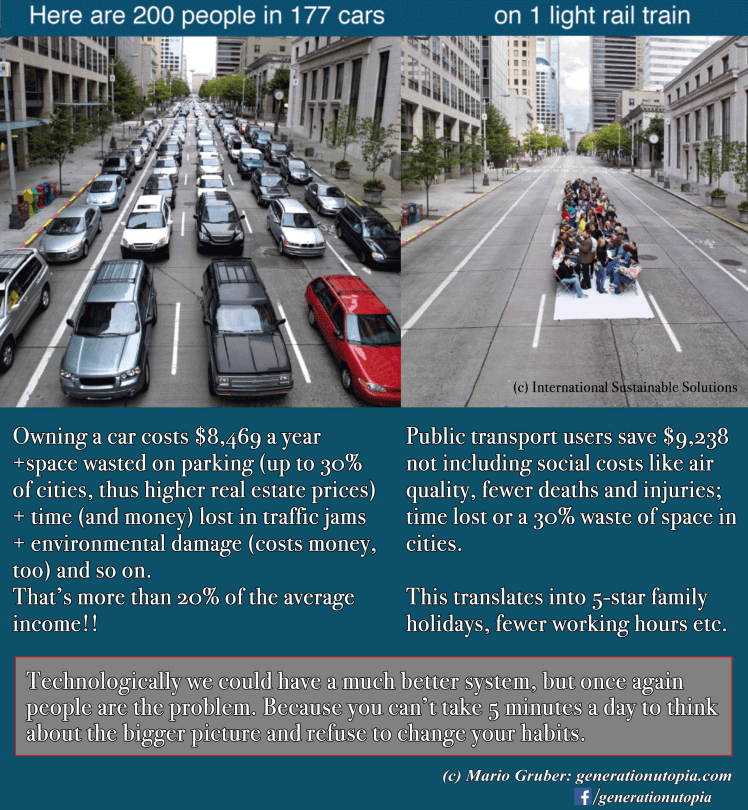
Transport is arguably one system in our modern civilization that has gotten worse, i.e. less efficient, overall over the past generation. Our economy has almost grown three-fold in the last thirty years and that has translated into more and better products and services. Yet, traffic has gotten so bad it often takes us longer to get from A to B than people a generation ago. I think traffic, especially in cities, is quite literally insane. It is insane that we have all let it get this far. It is insane that so many people spend a double-digit percentage of their income on cars even though they are parked and unused 96.5% (1) of the time. It is insane how technologically there are much better alternatives, much more efficient and much cheaper, yet we cling to our cars. The ideal case of transport, if we worked towards it, would easily grow our economy by ten percent and have a multiplier effect that would leave even Jesus’ fish multiplying trick look silly.
How we got ourselves into this mess
The automobile changed civilization and our lives in such a revolutionary fashion, academics put it at the core of our fourth techno-economic paradigm, a technology so important and pervasive that it acts as an enabling technology for the entire economy. Essentially, the car enables the way of life we developed after WWII. In 1950s USA it allowed the middle class to live further away from work yet still be able to reach destinations and to become stronger consumers. The term paradigm implies that the car became the way we all think about transport, from engineers to city planners to politicians and people. It became the go-to solution.
Firms advertised the car along the lines of personal freedom and we became used to this standard. Cars made a lot of sense and made life much better, there’s no denying that. However, over time a kind of trajectory evolved where the car paradigm became more and more embedded into our lives. Because we like cars, politicians love giving the people more and more roads. The car industry benefit from economies of scale where unit costs drop lower and lower and cars become cheaper. As car and oil companies turned bigger, they growingly became a so-called ‘preferred group’ that has influence over politics. So you see, there are several trends that reinforce each other, i.e. the more of this, the more of that etc. Finally, this created a situation of lock-in, where every side has a vested interest, made enormous investments, enjoys a great return and depends on the paradigm.
This car paradigm has gotten so bad, there are almost as many cars in the developed world as people. In fact, there are around 0.75 vehicles per person in Austria and 0.83 per person in the US (2). Public transport on the other hand is used by just 32% of Brits, 36% of Germans and only 21% of Americans (3). In fact, alternatives, such as public transport, became more and more disadvantaged in relative terms and are thus overall (a) a less attractive (valuable) transport mode.
Analyzing the current transport paradigm
Over time, more people have become able to afford cars, yet we couldn’t build enough roads. And now we are stuck with a system where we have too many cars and alternatives are not good enough. So public transport is often an inferior transport method. You can’t reach all destinations, you might not get the flexibility and comfort you like. This creates a prisoner’s dilemma where, as an individual, to change from owning your own car to public transport would just make your life worse. Hence, as long as you can afford it, you stick to your own car. If you did a cost/benefit analysis, your car would win – it has more value to you than public transport and taxis would be too expensive. But is that right?
As I explained in my multiplier effects of innovation article, we humans are not that good at considering anything outside our immediate context. But let’s take a closer look and dig deeper into how expensive the current personal car paradigm really is (numbers based on US, but similar in rest of developed world):
Owning a car (incl. fuel, insurance etc.) costs around $8,469 (4), which is a staggering 15% of GDP per capita! But that’s not close to the real cost, at least not in terms of opportunity cost, in terms of what else we could have. In this great video Mobility Lab and Vox point out a bunch of hidden societal costs of our car paradigm. Parking can make up up to 30% of American cities. That has to be paid for somehow, by someone, eventually either through your taxes or making products and services more expensive. Due to all this parking space, real estate prices are higher, so you are literally also paying more rent/mortgage, because of our car paradigm. Next up, consider all the time lost in traffic. People lose about 42 hours in traffic jams on average (5), which is more than a whole working week. In monetary terms that’s $936 based on average salary and $1,400 wasted in fuel costs. You see how we are looking far beyond the immediate context and how valuable that is?
The point here is not just that the costs of our car transport-paradigm are staggering, but more important is how much value we could gain if we switched. For example, all this space reserved for cars (i.e. roads, parking etc.) could be used for other things, e.g. housing, business, parks etc. The value of that alone would be in the trillions of dollars and drastically raise our quality of life. Even better, much better: Imagine if we could do away with the majority of cars. Imagine the trillions of dollars saved, which we can now spend on other things like health care or traveling (more below).
Of course, these are just opportunity costs and projected numbers, but it’s crucial to think outside of what we are used to in order to find truly excited potential. If you go really deep and think really hard you can realize where the multiplier effects are hidden. The problem is that we get really used to things, ignore the disadvantages over time and our habits become so strong we don’t like to change them unless we don’t really have to. We are humans.
What about the alternative?
We should do whatever is most efficient. It’s that simple. In very rural areas owning your own vehicle might always be the most efficient solution. In cities and urban areas a combination of underground (barely any wasted space), trams, busses, shuttles and taxis would be most efficient. So let’s do a quick cost-benefit analysis for these, too.
It costs about $250m per kilometer to build an underground (a nice, comfy one with LTE and air-con) (b). An underground system in a city like Vienna is about 83km long. That means it would cost around $21bn to construct the entire underground system for the whole city. That’s a lot of money for one government to justify to take out of the budget or create in new debt. But it’s actually nothing, only about $11,500 per Viennese. Just that the underground system is there for like a hundred years, so the fixed cost of building an underground is $115 per Viennese per year. Including variable cost maybe we’re talking about up to $500, but it really doesn’t matter. It’s still so much cheaper than our car paradigm, plus the result is a much more efficient city, with much more productive citizens. It would even pay off to build two tubes on every line or three, to accommodate not just for the people using the underground now, but to prepare it for everyone.
As mentioned in my multiplier effects article, if you focus on efficiency (maximized input/output ratios) through innovation you’re creating tremendous value – out of nothing – and all conversations about debt become redundant. Who cares about 5% more debt (the $21bn) if the return is many, many times greater?
Looking for the optimal transport solution. The compass is efficiency
Of course, not everybody wants to ride the underground: They stop at each station, they don’t get you exactly from A to B and they might be less comfortable. What about something even better? I suggest we look at the absolutely most efficient form of transport and then work towards making that happen. Because considering the insane costs and waste associated with our car paradigm, the theoretical potential of an optimal solution is worth easily 10% of our economy. What do I mean? As mentioned before, cars are parked around 96.5% of the time and they take up many times more space than what is actually necessary (see graphic at top of article).
Why do you need a car 100% of the time if you just use it 3.5% of the time? The sharing economy says hello. This is how Uber is already a cheaper and better mode of transport than owning your own car in many cities. Hence, if we all use taxi-apps, supply would rise so high, prices would drop to a minimum while availability gets to the same level as owning your own car (c). If we all just understood this it would change the world. But, even Uber is still far from optimal efficiency, so let’s go a little crazy.
Shared autonomous vehicles (self-driving taxis)
One of my favorite studies of all time shows that in an optimal system we would only need around 10% of all cars currently in existence, even through peak-times, to cater for the entire transport demand (6). That is, if the vehicles are self-driving. In this ideal case we could spend 90% less on cars (maybe slightly more accounting for firms’ profits), which would make the entire cake of the economy larger by almost 10%. Even if you don’t own a car yourself and wouldn’t save money directly, we all live better lives if the economy grows by 10% (people losing jobs in car industry, but will balance out, subject of another article).
Imagine a system in which the vast majority of us no longer have to pay 15% of our income for our own cars, but a subscription model of $1,000 to take a self-driving taxi anywhere, anytime. There will be 90% fewer cars in traffic and parked, imagine that! Yet, there will still be a shared autonomous vehicle (SAV) available within less time than it takes you to walk to your car, or find a parking spot, respectively.
Feasibility and Cost
Obviously self-driving cars are not quite ready yet, they will take a few more years (d). But so does the construction of new roads! Yet, right now we only think two-dimensionally (input/output), that is, if there are more cars we need to build more roads, which makes more people get cars. This logic, which we constantly follow, is really ignorant. It only creates value marginally.
The main point I made in my multiplier effects article is that if we look deep enough and realize the full potential of an innovation, or a change in other words, to drastically raise efficiency (or drastically lower inefficiency) we’re truly creating value, which translates into better lives. But only, and really only when we focus on efficiency. Nothing else matters. Raising efficiency through innovation is what has gotten us forty-times greater economic output and living standards over the past 500 years.
Of course, there will be many new costs involved with more public transport and SAVs, which I have not accounted for in this article. But even if various variable costs double the overall costs (unlikely) and my basic calculations are off by 100%, this new transport system would still be many times better than the current.
What should we do?
We established how the current transport paradigm evolved and how it’s not extremely hard to change, how it’s hard for us people to change. At the same time, it’s technologically possible to build a completely different transport system that would change the world forever.
Where we have two options to pursue and invest hundreds of billions of dollars into transport, we should choose the option that is trillions of dollars better considering all factors. It’s that simple. That system is much better public transport combined with SAVs, and even flying shuttles, drones for delivery etc., for that matter. Whatever has the potential to drastically raise efficiency is what we should go with. That’s the logic of multiplier effects.
This change takes several steps: First, we need to get the technology right. Looking at humanity’s track-record of building a million different technologies in a row that would have been magic to people the generation before I’d worry less about that. Firms also need to change, but as noted above, car and oil companies have massive vested interest. Business does, however, follow the money. Hence, the most important step by far is for society to change, for us people to change our silly habits. Realizing the massive potential return this change would bring us, should be a much greater motivator for people to change. That is why I wrote this article and do research (PhD) in exactly this field. Lastly, policy makers have tremendous power to balance out this prisoner’s dilemma and market failures, to put up massive initial investments, support R&D in autonomous driving research and so on and so forth.
So two crucial actions are needed:
- Educating the public on the actual cost of the car paradigm and the potential benefits of a public transport/SAV paradigm as well as a new way of thinking – the multiplier effect logic instead of two-dimensional thinking. I’m trying to do my part.
- Politicians need to recognize the same and enable this change with a range of policy measures.
References:
1. Bates, J., Leibling, D. (2012). Spaced Out: Perspectives on parking policy. London: RAC Foundation.
2. Myers, J. (2015). These are the countries with the most vehicles per person. World Economic Forum. Available online at: https://www.weforum.org/agenda/2015/10/these-are-the-countries-with-the-most- vehicles-per-person/
3. Dalia Research (2017). How the world moves: Exploring global mobility data. Available online at: http://mobility.daliaresearch.com/dashboard
4. AAA (2017). AAA Reveals True Cost of Vehicle Ownership. Available online at: http://newsroom.aaa.com/tag/cost-to-own-a-vehicle/
5. Jacqui Frank (2017). Here’s how much time and money you waste sitting in traffic a year. Available online at: http://www.businessinsider.com/time-money-spent-traffic-per-year-us-cities-new-york-los-angeles-san-francisco-atlanta-2017-2?IR=T
6. Guo, H. M., Cao, Z., Seshadri, M, Zhang, J., Niyato, D., Fastenrath, D. (2017). Routing multiple vehicles cooperatively: Minimizing road network breakdown probability. IEEE Transactions on Emerging Topics in Computational Intelligence, 1(2), pp. 112-124.
Footnotes:
a) In some areas it is very good of course.
b) If we gave automation a chance, that cost would drop significantly as well and create another massive, reinforcing multiplier effect, but that’s for another article.
c) In many cities you only wait two minutes for an Uber.
d) They might not be able to drive everywhere and in all situations.
 Generation Utopia