
What if there were things that we could do or change about our world that would get us twice the money without working any more hours? “Well”, you would probably say, although somewhat jokingly, “where do I sign up?” The cool thing is, that it’s definitely possible. In fact, we have gone from living on the equivalent of $1,000 a year (in terms of value of goods and services) just 500 years ago to $40,000 (a) today. Isn’t that incredible? This fortyfold increase means much better health care, education, housing – virtually every aspect of life. Imagine if there was a pattern to that growth, something at the center of it all, something to prioritize.
One thing is clear, we can continue growing the economy and making life better as long as we are nowhere near maximum efficiency – in theory at least. And that theory is innovation theory. The key, as I will explain in this chapter, is to go beyond what we are constantly doing and to think a bit deeper and recognize the changes – the innovations – that have a multiplier effect. There are things that don’t just save $100 or create 100 jobs straight away, but that come back like a boomerang saving $1,000 or creating 1,000 jobs. For example, childhood immunizations save 44 dollars for every dollar spent on them (b). But in order to realize that you need to go a bit deeper, make new connections and find these innovations. That’s really hard, but not if you get the logic right.
Of course, to maintain our economy and living standards, we first have to do, what we have to do. Farmers are needed to produce food on a daily basis, doctors to treat patients and shops to sell things. In a sense, we have to put in 100%, i.e. do our jobs, in order get 100%, i.e. goods and services. But what could we do in order to get 200% while doing the same amount of work or, perhaps better, get the same living standards for 50% less work? That’s a trillion-dollar question. Let’s answer it.
Quality of Life Has Improved Many-Fold Already
In a nutshell, this is what the economy looks like – we have inputs (work, resources) and outputs (b).
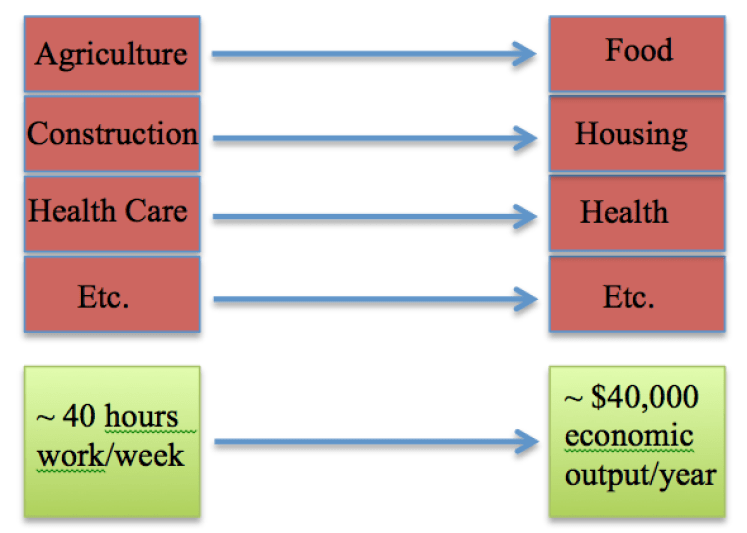
You can picture this view of our economy as two-dimensional: The first dimension represents the inputs (resources, labour etc.) and the second dimension all goods and services. Hence, here is another silly visualization that’s not textbook economics, but it serves its purpose.
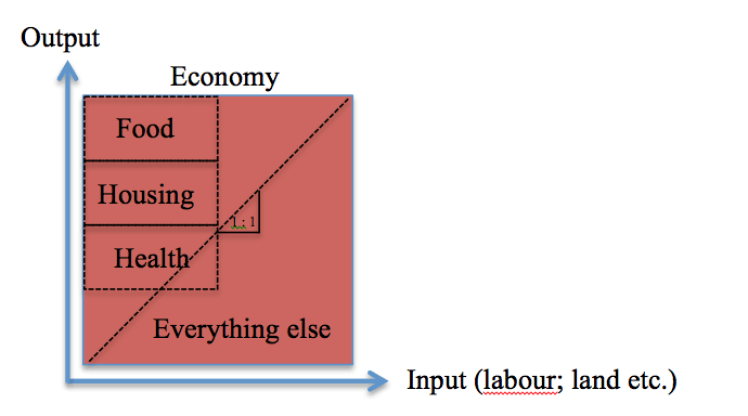
This also shows you a linear relationship between inputs and outputs, i.e. 1:1, as each unit of input gives you one unit of output. Simple. So this creates an image – a two-dimensional surface – of all jobs, all money, all products and all services. It’s what we see, it’s what we do every single day and it’s what we consume. We go to work, we get money; we create jobs, more people have money; and so on. However, I posit that this view limits our ability to see the bigger picture.
For example, Thomas Malthus already proclaimed over 220 years ago that you can only grow x amount of food with x amount of land and labour. But as we all know today, he was totally wrong. He only connected, more or less, two variables, which he considered input and output. His view was confined to that two-dimensional image, and he was ignorant to the stuff below the surface and he was incapable of looking deeper. For example, he had no idea how science and technology (e.g. machines and GMOs) would expand that image (in a sense stretch every pixel) he had. In a sense, this means going below that two-dimensional image or surface into a kind of third dimension, a dimension of space. After all, we produce more food than two centuries ago yet put in way less labour and land in relative terms.
And that applies to the economy as a whole, every product and service. You see, at some point in the past, before the industrial revolution, our economic output was only around $1,000 per person per year even though we probably worked sixty hours a week. So how on Earth did we grow our economy so much without increasing inputs by a factor of forty? Good question. Best question ever! Truly understanding the answer to this question, at a deep level, is the key to changing the world and to creating a Utopia.
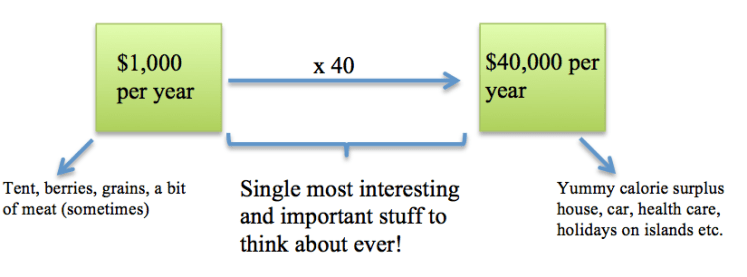
Our days didn’t get longer and no Jesus magically multiplied fish and bread and iPhones. But some stuff happened, slowly over time that multiplied every single unit of input (e.g. our work time) giving us forty times more in return. So, we’ve already increased our economy 40-fold out of nothing, i.e. without working (40 times) more. This is what I call the multiplier effect (c) of innovation. Because the only reason why we have forty times more, and really the only reason, is because we are doing better (more efficient) things better (more efficiently). Imagine if Malthus wrote a famous book about focusing on the science and technology of agriculture.
By the way, if you feel like we’re not getting forty times more nowadays, try to live with $1,000 a year, i.e. primitive shelter, fruits and grains and only one chicken breast a week, and you’ll realize how much better we have it today.
The Cake that Got 40 Times Bigger
Imagine the economy as a cake (one of my favorite metaphors). We managed to make it forty times bigger and give everybody a much bigger piece instead of fighting over how to allocate tiny pieces of a tiny cake. The issue is, however, that this growth only came to fruition over hundreds of years. In the following I’ll explain why I think that 97-98% of the time we still only think two-dimensionally and where we miss these multiplier effects.
The Inefficient Village
Because it’s always harder to see what you are doing wrong yourself consider this thought experiment about a village 500 years ago to illustrate my metaphor of making the cake bigger: Imagine watching villagers in the year 1,500 debate over how to allocate the $1000 GDP/per person, perhaps by creating more jobs so more people would have an income and better lives. That’s not wrong per se, but it’s not enough.
They were ignorant about how inefficient their roads, agriculture, and everything else was. They didn’t understand the value of science and technology, and ultimately, innovation (more below), to the extent that we (some of us at least) do now. They only saw their own little world – imagine a village from a bird’s eye view – their own jobs and kept doing what they always did.
If you showed up, you’d run around all day going mad about how dumb they did things and you’d be the person in the village obsessed with pointing all the inefficiencies out. Not because it’s a fun game, but because it would translate into better lives. Just to give one example, you would try to convince the villagers to boil water so they don’t get ill – a really valuable innovation I’m sure you’ll agree. Makes sense right?
I think the same thought experiment applies nowadays too, however, we are also ignorant to the stuff below the surface. We also just think linearly for the most part. Just imagine how our great-grandchildren will view us as extremely primitive – everything we do, how we do it, from transport to health care to everything else. The difference between poor villagers or our ancestors is, however, that they cannot be blamed for not knowing. We, on the other hand, already know exactly what to do. To look for the things that are outside that two-dimensional input/output ratio and increase it, in a sense going below the surface into a third dimension, is the key to building a better world.
How We Are All Guilty of Thinking Two-dimensionally. Yes, Even You.
While science and technology have evolved tremendously, our brains haven’t changed in the past 500 years. We have the same cognitive dissonances; we all still live in our own little worlds where we can make sense of things. To zoom out and be critical or consider the bigger picture is not easy.
Think about what kind of measures to make people’s lives better we discuss today. What would come to your mind? Politicians always talk about creating jobs, lowering taxes, reducing debt, putting more money of the budget into health care etc. In other words, right wing politicians want to divide the cake this way, left wingers that way. “Stimulate demand so people buy more stuff; create jobs and reduce the unemployment rate” are things we hear all the time. The media writes about the very same topics. But consider this: even with full employment, high consumer spending, low taxes and the best budget plan, people’s lives in that village 500 years ago would have not gotten forty times better. So why are our brains focused on this almost exclusively today?
Now, I’m not implying such measures are useless. In fact, they are really important. For example, unemployment and low demand imply lost value in the economy as the input/output ratio is not maximized. Economic depression is another thing you want to avoid. Especially perception-wise, we can’t tell people to be happy after they’ve lost 20% of their income, because they are still much richer than their great-great-great-grandparents. However, we hit a wall with measures such as job creation very quickly and they can even turn into what I like to think of as a zero-sum game. How’s that?
You can only ever have these conversations (and therefore what jobs to create, what the budget is etc.) based on the (static, current) value of the economy. That’s $40,000 nowadays instead of $1,000, but the same principle holds true. After all, that village 500 years ago could have had full employment and optimal taxes, zero debt and no economic depression ever. If they always kept doing what they were doing at the same rate of efficiency, they would have still lived lousy lives compared to ours.
So Where Does Increased Efficiency and Hence Value Come From?
All the above strategies for improving our lives are really about the same thing: Increasing value. For the most part value is economic output in the form of money (d), products and services, but can also mean more free time, freedom in how you live your life etc. Value implies better living standards and better lives.
So, we care about jobs primarily because they mean people can live better lives being able to pay for stuff that gives them value; we care about taxes because we want people to have more money in their pockets (for the same reason), and so on. But as long as the entirety of value is not larger (or the cake does not get bigger), you are pretty much just talking about dividing the cake differently. Having established that we know what we really need to look at is creating value. And we do this by increasing efficiency, in the sense that we (somewhat magically) increase that two-dimensional input/output ratio by going into the third dimension. After that we also need to look at how to allocate that additional value (as money) so that not just the rich get richer, but that’s for another article.
So, without additional efficiency even creating jobs doesn’t increase value. Overall a nation’s people will not be better off. For example, imagine if we were to reintroduce the job of gas station attendants. New jobs would be created but petrol would be more expensive taking money out of everybody’s pockets, so it could likely just be a completely useless, zero-sum-game measure.
Because We Don’t Focus On Value, We Miss the Bigger Picture
If we recognized this and worked on these linear measures to the degree that is necessary, but then realized we had to go beyond that, into the third dimension, to look at the measures that actually make that cake bigger instead of dividing it differently (creating jobs), it would be okay. But we don’t. Take this striking example of a two-dimensional logic: “We have to increase the retirement age, because otherwise an ageing population couldn’t be taken care of. After all, with more people not working (and producing an input), a rise in pensions (increasing output) cannot be sustained.”
What terrible logic. I’m in favor of keeping experienced workers in the economy longer if they want, and while it’s not unreasonable that people work a bit longer if they live longer, this cannot be our go-to solution. We take the one truly linear input in our economy, human work, and make an increase in output dependent on it. And in the process we force older people to work longer. We consider this input/output measure, limited to a linear growth curve, over efficiency-increasing measures that can be exponential. I think that’s really irrational.
As much as you might think that creating jobs or all these linear, surface-measures matter, they’re only the equivalent of treating symptoms (e.g. ulcers) instead of the underlying cause or disease (e.g. herpes). On the other hand, if the symptoms disappear, then so has the cause (with exceptions of course). Right now the US has the lowest unemployment rate of all time and economic growth was at an incredible 3.2% in the first half of 2017 – this is truly a golden age. When there is full employment (among other factors) it also means that innovation and growth in prosperity are taking place. On the other hand, low unemployment is really just an indicator (symptom) of things going well, not necessarily the cause.
Think about this from your own perspective. These linear approaches are like saying you need to work more hours if you want to make more money. Not wrong, but not the best option. The better option is to get an education, if you can, and make considerably more money per hour later. Even if you have to pay for the education, your higher salary will more than make up for repaying the loan you took or investment you made. You will barely find any construction workers that will make more money than someone with a degree in economics (e). So education is a smart move – smarter than working more hours. Education has a multiplier effect. Get it? In fact, education has the largest multiplier effect of anything (f) and should therefore be an innovation to obsess about. Education systems around the world alone are so extremely inefficient and ineffective at what they are supposed to do and so expensive, but that’s for a different article.
Connecting All the Dots, In the Third Dimension
Here’s an example that’s already not so straightforward and goes a lot deeper: Transport. You’ll see how the deeper into the third dimension you go, and the further away from conventional, two-dimensional, input/output thinking, the bigger the multiplier effects that you will find. Let’s do the exercise: When traffic gets bad we build more roads and parking to cater for more cars. The conventional logic is that people use cars to get from A to B and thus in this logic if we take transport as output, in the two-dimensional way of thinking we all apply almost constantly, the logical solution would be more roads.
But think about how inefficient our modern transport system is, it’s one of few things that literally got worse over the past generation (i.e. it often takes us longer to get from A to B). Your car is parked 96.5% (2) of the time! And cars cost $8,469 a year (3), about 15% of GDP per capita, and that doesn’t consider societal costs. All this space wasted; all this parking (hence higher real estate prices); all these traffic jams; the time wasted; injuries and deaths; environmental damages. Public transport is much more efficient and much better scalable and much, much cheaper when you consider all the costs from deeper levels. We should have a system with underground trains everywhere, shuttles, busses, taxis, because private car ownership is practically insane. Ideally, these forms of transport would be self-driving as well.
We’re talking about a double-digit percentage of the economy here. We get the same output (or even better, faster etc.) for way less input, which can now be applied elsewhere. Of course, we can’t just build self-driving cars – the technology isn’t ready yet. But believe me, the technology would be ready in no time if society and politics really wanted it to. Cutting the unemployment rate doesn’t happen over night either.
Follow the Innovation Logic
What this is all really about anyway, is the approach we take and the logic on which we base our actions as individuals and collectively. Right now, they’re always just two-dimensional, surface measures. It’s not a secret that public transport is cheaper, but who, as a citizen, goes and tries to calculate by how much really, considering all variables, and then makes personal changes in order to contribute to positive change based on that bigger picture? But that is precisely the key, to go deep into the third dimension and recognize the multiplier effect of innovations and hence the potential, enormous value to all of us.
Humans Are Irrational And that’s the Problem
People really don’t want to change their habits though. They like their cars and don’t want to give them up (believe me, I wrote a dissertation on this). Cars are our status quo; everybody thinks cars (and a bit of public transport). Hence we created a socio-technical transport paradigm and a lock-in situation. Politicians talk about building more roads because that’s what we love. And so on. If you switch to public transport it’s just a pain for you, they’re not fast enough yet and don’t reach all destinations, so you are not willing to pay more. A prisoner’s dilemma follows where individuals changing their actions does not benefit them unless the majority also changes.
Still About Value
Like with jobs, we build roads because we want to give value (transport) to people. So again, we talk about value – additional value out of nothing. And we love value. But I argue we fail to innovate the transport system because we are too ignorant of the bigger picture, of going deeper and recognizing the whole multiplier effect, because that makes you understand the entire value an innovation can create, and not just the immediate effect. In that sense, self-driving cars are not just great because you can relax, but because they mean you don’t have to own your own car anymore and can save thousands upon thousands of dollars a year (and other reasons).
A Simple Cost (Don’t Matter)/Benefit (Gigantic) Analysis
But again, to get to that point we have to first incur costs (e.g. switching costs), we have to change, which might not be comfortable, and we have to make investments. That’s a chasm that is extremely difficult to cross, especially if we also apply a static or linear way of thinking.
The most frequent and most annoying question regarding any grand innovation is: “But how are we going to pay for it, where are we taking the money from to pay for it?” For example, here in Austria we have extremely tough entry exams for medical students, because the (free) university does not have the budget to accommodate for too many aspiring doctors. “There just isn’t enough money in the budget”, they say. At the same time we have a lack of doctors.
That is so closed-minded it’s actually insane. Do you envision a future where we have the same long waiting times in ER (or A&E); where you have to wait months to get a surgery and fifteen minutes until an ambulance reaches you when you have a heart attack? Unless we have so many doctors that they’re mostly sitting around the cost for their education will pay off many times over.
To not make investment now for things that increase efficiency and the overall value in the economy because of a multiplier effect in the third dimension because you cannot look beyond the second dimension is dumb. It reminds me of that experiment with these kids where they asked them not to eat a marshmallow that’s in front of them so they would get a second one ten minutes later. Don’t be the kid that eats the marshmallow straight away. Have more self-control than that kid, work on changing your habits and thinking beyond the marshmallow that’s in front of you for ten minutes a day. Maybe it would be easier if people understood that they’re not just giving up one marshmallow now, for one or two later, but ten.
This is in no way a revolutionary view. It’s basically what business do when they calculate a return on investment. They collect all the data they can get their hands on on both potential costs and returns, throw in some probability calculation and whatever has the highest net present value, they do.
How It Benefits YOU!
There are things so outrageous you would think would move every single citizen to act up and do something, like extreme poverty, homelessness etc. But we don’t really ever care if it doesn’t affect us directly. Okay fine. But let me tell you that this stuff definitely affects you, to resist innovations because of petty fears and intellectual laziness makes your burgers more expensive, or whatever else you care about.
This is why looking at that third dimension and what got us this 40-fold increase in economic value, and then adapting our actions, is the most interesting and most important thing we can do. You might think that’s a bold claim and tell me that spending time with loved ones or your purpose in life or being happy is more important. Yet, for every minute we invest in thinking about and doing things contributing to the multiplier effect we get many more minutes (and resources, knowledge, technology etc.) in return to do the other things.
You see, no matter what you care about and what gives you value, e.g. better health care, making a living off your art, more holidays etc., the easiest way to get everybody what they want is by making that cake larger (g).
And so instead of sitting at a table debating who gets which pieces and how big they are we could actually focus on making the cake bigger first. We should, just like we would if we travelled 500 years back in time, obsess over efficiency, because efficiency means changing the ratio of inputs to outputs from 1:1 to 1:1.01 or 1:40. It means we make the cake bigger. Looking at the transport example again, if we took it to the extreme with shared autonomous vehicles, public transport etc., and made these transport modes just as comfortable and flexible as owning a car, we would get the same output with much less input. In this case, I posit, over 10% of GDP.
When that happens we create value – out of nothing, i.e. not by working more. And value can mean what we make it, better living standards, more time to find love or think about the purpose of life or create art or care more for the environment.

Even if the most important thing to you is art, which has little to do with science, technology, economics or politics and you have no interest in how great smartphones or computers are, innovation is still at the center of your world and value is still the currency of all different things you care about. Because art is a certain fraction of the economy, statistically it is easier to become an artist in a rich society than a poor.
Innovation – Uniting It All
There are many different takes on what innovation really is that is better left for another article. In a nutshell, there are five essential inputs to innovation – science (knowledge), technology (applied knowledge), economics (creating value from science/technology), politics (building framework) and society (positive change ultimately depends on us, the people). Innovation can be strongly technology-focused, but innovation can also occur in the social realm (e.g. a better education system).
We established that the goal is to do better things better – or more efficiently – and to increase the input/output ratio in order to attain more value, which can then make our lives better in whatever ways. All the questions and answers involved with that goal as well as all knowledge and actions that contribute towards it can be summarized as innovation.
Science and technology then are the most valuable things we humans have ever done or can ever do towards improving our lives. Yet, how much are we investing into them? That’s almost a rhetorical question. And when new technologies advance exponentially, we humans just stand around and react in the same way as we always have – fear and ignorance. I’ve written more on the lost potential due to the last important key in innovation, society in this article called the Caveman-smartphone Metaphor.
The Ultimate Multiplier Effect: Automation – Making All other Innovations Look Like A Kindergarten
Automation (including artificial intelligence) has a bad reputation. It takes jobs, and after all, in our two-dimensional way of thinking, that’s bad because it means big corporations will have greater profits while we have less money in our pockets. Not entirely wrong. However, if done right, i.e. if we tax automation and redistribute wealth to those who lose jobs; if we invest more in education and upskilling etc. etc., then automation can be the best thing we can do if we want to live better lives.
Better lives, in this generation, I think mean working less and having more time to do what you love. It is the ultimate example where all traditional debates about budgets and jobs no longer matter and conversations about universal basic income start. Automation is the holy grail at this point in our civilization. It has the greatest potential multiplier effect, because it creates outputs that are no longer limited by linear, two-dimensional inputs, i.e. human labour. Automation can increase output not linearly, but exponentially.
Imagine robots that build robots that build and repair robots that create goods and perform services. There is almost no limit to how much we could have and how much we could reduce our working hours and still (provided we allocate the money accordingly) have everything we need. Furthermore automation and artificial intelligence are more and more able to perform work that humans could no longer do, i.e. better; more output.
For example, many large buildings (e.g. offices or shopping centers) take about two years to construct. It takes a lot of workers (let’s say 30% of the overall cost), time and resources to erect it. Now we could speed that process up by adding more workers, but that will only give us a linear return, e.g. if we add 10% more workers the building might be finished 10% sooner (h).
Whenever I look at skyscrapers going up I just imagine a bunch of robots, coordinated to a T, putting in steal beams every few seconds, windows straight after etc. Imagine how much faster buildings would be finished. And realize how much cheaper construction would become. Once robots are purchased they’re marginally free (no salary), they work day and night. If they break other robots can repair them. Obviously there are two caveats to this, the first is technological and the second socio-political:
- I know we don’t have robots that capable yet, but thinking in this logic makes you understand why we should support the development of such technologies over obsessing about new jobs in construction and keeping the system in the old, locked-in, two-dimensional way. We only need to program the system once, only develop such robots once. Looking at the multiplier effects and how such technology could be worth many trillions of dollars justifies whatever cost.
- People would lose their jobs. Society and politicians don’t like that at all. But that again is two-dimensional thinking. Remember how full employment in an underdeveloped village is not what grows the economy forty-fold? Despite jobs lost, the output, in this case housing, would still be the same if not better (quality and quantity wise). We will have so much more additional value (read: money) and so much more time, figuring out how to reallocate value to people will be child’s play. It will really not be the hard part, but by far the easiest part. A universal basic income is just one idea. Plus obviously we can create new jobs. It’s what we have been doing for hundreds of years. Even right now, with the highest automation rate in history, the US unemployment is at its lowest point. So in the future there could be one teacher for every five children instead of every twenty; three times more doctors and nurses; more artists; and of course many jobs we don’t yet know of.
So if we follow the multiplier effect logic and the pattern that got us from $1,000 to $40,000 we can see that increasing efficiency can be done the fastest by automating. While people lose their jobs and thus small pieces of cake in the short run, we can find ways to give them bigger pieces of cake after we made the cake bigger.
The Low-hanging Fruits You Can Also Pick
Of course, to change the entire transport system or automate half the economy is a little Utopian and not so easy. Science and technology also bare risks; innovations might not work; and in some cases there are often diminishing returns in R&D.
There are, however, countless little daily inefficiencies, as I call them, which we can change relatively easily, that could create trillions of dollars of additional economic growth. I’m serious. I personally made an art out of noticing inefficiencies – in the street, in shops, companies, policies and society at large. I really have pretty much nothing else to do. Again, future articles and videos will cover all that, but it’s a lot.
Here’s an article I wrote about queuing (lining) up in retail and how it’s a pure waste considering self-checkout technology is ready, yet adoption is taking much longer than necessary. Noticing these daily inefficiencies requires a certain innovation habit. But the more we, society, a) notice inefficiencies and b) stop thinking closed-minded, two-dimensionally and realize that there could very well be hidden multiplier effects, the more innovation can make our lives better.
References:
1. Gates, B. (2017). Annual Letter. Available at: https://www.gatesnotes.com/2017-Annual-Letter?WT.mc_id=02_14_2017_02_AL2017_BG-POL_&WT.tsrc=BGPOL
2. Bates, J., Leibling, D. (2012). Spaced Out: Perspectives on parking policy. London: RAC Foundation.
3. AAA (2017). AAA Reveals True Cost of Vehicle Ownership. Available online at: http://newsroom.aaa.com/tag/cost-to-own-a-vehicle/
Footnotes:
a) In large parts of the developed world.
b) This is a simplification just to illustrate the point – of course there are other inputs to “health”.
c) Yes I know that’s a term from monetary policy, I stole it hehe.
d) Money is, by the way, itself just a representation of “value”, hence of goods and services.
e) I don’t want to philosophize about exceptions. Some horses are also faster than cars, but you’re not going to ditch your car for a horse.
f) For society overall, not just for individuals.
g) Not just money, but value, so knowledge, free time – whatever we make it.
h) Not even because of diminishing returns.
 Generation Utopia