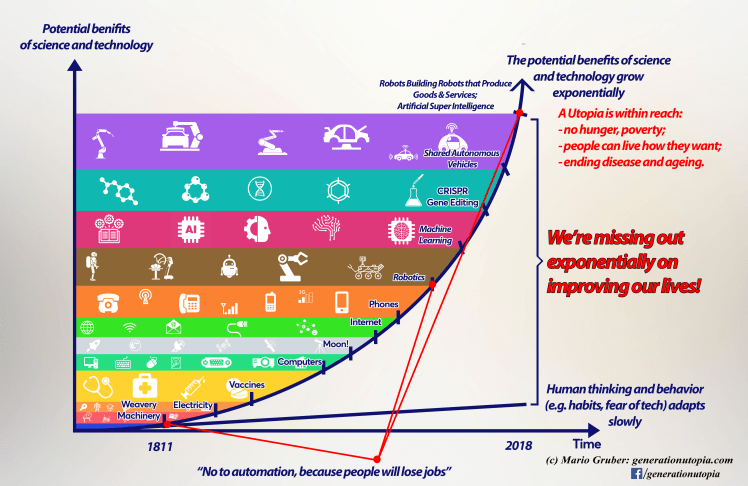
In this article I explain why I’m optimistic that the necessary yet substantial social change to build a utopia in the next generation can really take place. In fact, the more radical and revolutionary the innovation the easier it could be to bring about change, because people have better reasons to change their behavior or take action than with minor innovations. The social change necessary or the degree to which individuals need to adapt might grow, but it only grows linearly, while the value of more and more radical innovations grows exponentially. Therefore, it should be increasingly motivating, and not less like people usually feel, to go through with them. This is what I call the “exponential innovation motivation”.
There’s a pattern throughout history that incremental innovations (e.g. improving bronze tools or horse-drawn carriages) are easier to engineer and implement in society, but also much less valuable than radical innovations (e.g. iron over bronze tools and cars over horses). The radical, revolutionary and highly life-improving innovations depend on society changing big time. And it’s not like we can predict which innovations will be huge and benefit us all and then convince every single person on the planet of that vision. So things just take their natural course, society and products/services co-evolve between incremental improvements and, step-by-step, social change (i.e. acceptance). But what if we could speed this process up?
To reiterate the general GU-logic, the technological potential to improve our lives is exponentially greater than ever before, but to unleash that potential we humans need to really change our behavior, habits and take some crucial actions together. For example, we certainly have the technology and resources to end world hunger and save millions of starving children a year, but the societal and political will to take action is not quite sufficient. The same is true for fewer work hours (and more free time) or solutions to climate change. Technically we could make all that happen, but the bottleneck is usually that we humans simply won’t give up our beliefs and habits.
While society overall is more concerned about climate change and we do buy more sustainable products than a generation ago, change comes painfully slow. We continue to drive oil-guzzling cars and find renewables impractical or too expensive even though we know, or have at least heard from experts, that the cost of climate change is too great.
The problem is that it takes a lot of energy to have to think about the fate of the whole world every time you drive to the supermarket, so what we do to make life easier is form certain attitudes and habits which we simply follow. The point I want to make here is not just that we should care more about the environment or extreme poverty – that’s the obvious and you’ve heard it before. The crucial point I am actually making is that with innovation the reasons to change are much, much greater and so the usual logic of why we accept change is not sufficient when it comes to radical, high-value innovations.
For example, let’s compare car owners and users of public transport. For car owners it’s usually unimaginable to just switch to public transport. They’re used to the monthly expense so the cost saving of switching to public transport is not such a great motivation. For people who are used to public transport to suddenly pay several times more to get from A to B is extremely painful, thus it will not support any type of incentive for change. Moreover, car owners are emotionally attached to their cars, love the flexibility and don’t want to wait for an underground, etc. A car owner’s cognition and habits are strongly internalized so a “strong” or radical change in habits and lifestyle does not come easily.
In a sense, people don’t have good enough reasons to change. The perceived benefits to change are not quite big enough compared to the perceived costs (e.g. financial or discomfort of change). Global warming and starving children are abstract and distant issues, they don’t really affect us directly in our every day lives and we might feel like we can’t do too much about it anyway. Moreover, innovations are often not compatible with people’s values, beliefs etc. and the potential benefits In a sense there is a cost/benefit analysis occurring, conscious or unconscious, where because of beliefs and habits the perceived costs of change are exaggerated and the true potential benefits are not known or understood.
Here’s a visualization of this dilemma that takes place in many of us:
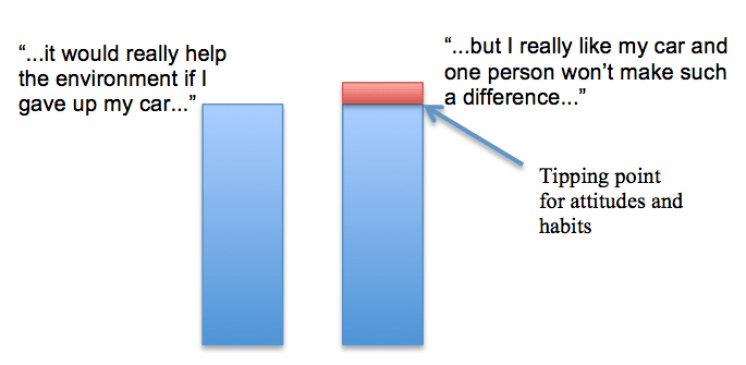
If, however, people understood the value of an innovation or change to be potentially much greater than initially assumed, then they will have a considerably stronger incentive to change themselves. Especially with innovations that have a great multiplier effect and bring us exponentially growing value, I think that if we did a good enough job at making people understand that, then behavioral changes will come much more easily. The point that we need to get across, in simple terms, is that for every unit of behavioral change people can expect multiple levels of benefit in return. Or in other words (still not more simple but interesting), that for linear change or adaptation of behavior and habits people get an exponential return.
For example, as I explained in my insanity of transport article the potential of self-driving cars is not just that the car drives itself, but that they can serve as taxis and save up to 15% of our income per person. So for giving up owning your own car and maybe having to take a few seconds to click three buttons on an app (relatively low cost, i.e. small habit change) we could get close to $8,500 in return.

That is the difference between traditional ways of thinking and the logic I am trying to get across. With most things, we give something up in order to get something in return. But as I explained before, innovation carries a multiplier effect. So while first we have an input and an output (e.g. spending $8,000 on a car to get to places) after we innovate we get a greater output for the same input or the same output for much less input (e.g. much lower cost). So when I explain the potential of shared autonomous vehicles to, for example, my grandmother, it comes down to making her understand one point: You’re not giving up one way of transport for another like in a zero-sum game, but the new system could be three, four or five times better than the old system that you are giving up.
Of course, we don’t know exactly what that new system will look like and nobody can guarantee that we will truly add over 10% of the economy. But the fact is that there is a pattern that because of innovation we have come such a long way, i.e. from cavemen to smartphone users. That’s how we have increased our economy 2.5-fold over the last generation. And with modern innovations the potential (emphasis on “potential”) benefit is greater than ever before. Therefore, the motivation to change or take action should be greater than ever before.
Research over the last generation has shown that time and time again the value or benefit of an innovation is the biggest attitudinal determinant of whether people accept innovations. When I talk to people about shared autonomous vehicles (my PhD research) they’re usually very skeptical and don’t like giving up their own car. However, when I tell them that they could save thousand of dollars a year, their attitude usually becomes much more positive. At this point I am only making hypotheses, but I think educating people about the actual, tremendous value of things like shared autonomous vehicles could double the adoption rate. Therefore, maybe shared autonomous vehicles could become the new transport paradigm in 7.5 years instead of 15. Considering the new system would create several trillions of dollars in value I argue any education campaign, even if it costs tens of billions, would be worth it, especially if people understood that they are getting a return themselves. But more on that in another article/chapter called “The marketing of changing the world”.
Once people do understand that, however, I think it can serve as a trigger to tip the balance from old behavior to new and therefore facilitate the diffusion of innovations worth trillions of dollars. This happens first through changing people’s attitudes and subsequently their behavior. I personally refuse to buy a car not just because public transport serves me very well anyway, but because I don’t want to stand in the way of the transport system changing to a much better version. That might sound complicated, but I’ve made a habit out of this kind of behavior, so it’s really low effort.
To conclude, people don’t like to change and only do so if they think or feel that they are getting something out of it. The potential of modern technologies is growing exponentially greater, but that also makes them harder to understand (e.g. their potential value) or adapt to considering we humans like to stick to our habits. Hence the key to changing the world is convincing humans to unleash more scientific and technological potential. And unlike minor innovations, radical innovations such as AI, self-driving cars, automation etc. carry such enormous potential value that change, e.g. of your habits, becomes much more worth it than in the past. That’s the exponential innovation motivation: The opportunity to shift our linear, slow, static human behavior by investing more into educating people about these opportunities and raise their motivation to change.
 Generation Utopia